
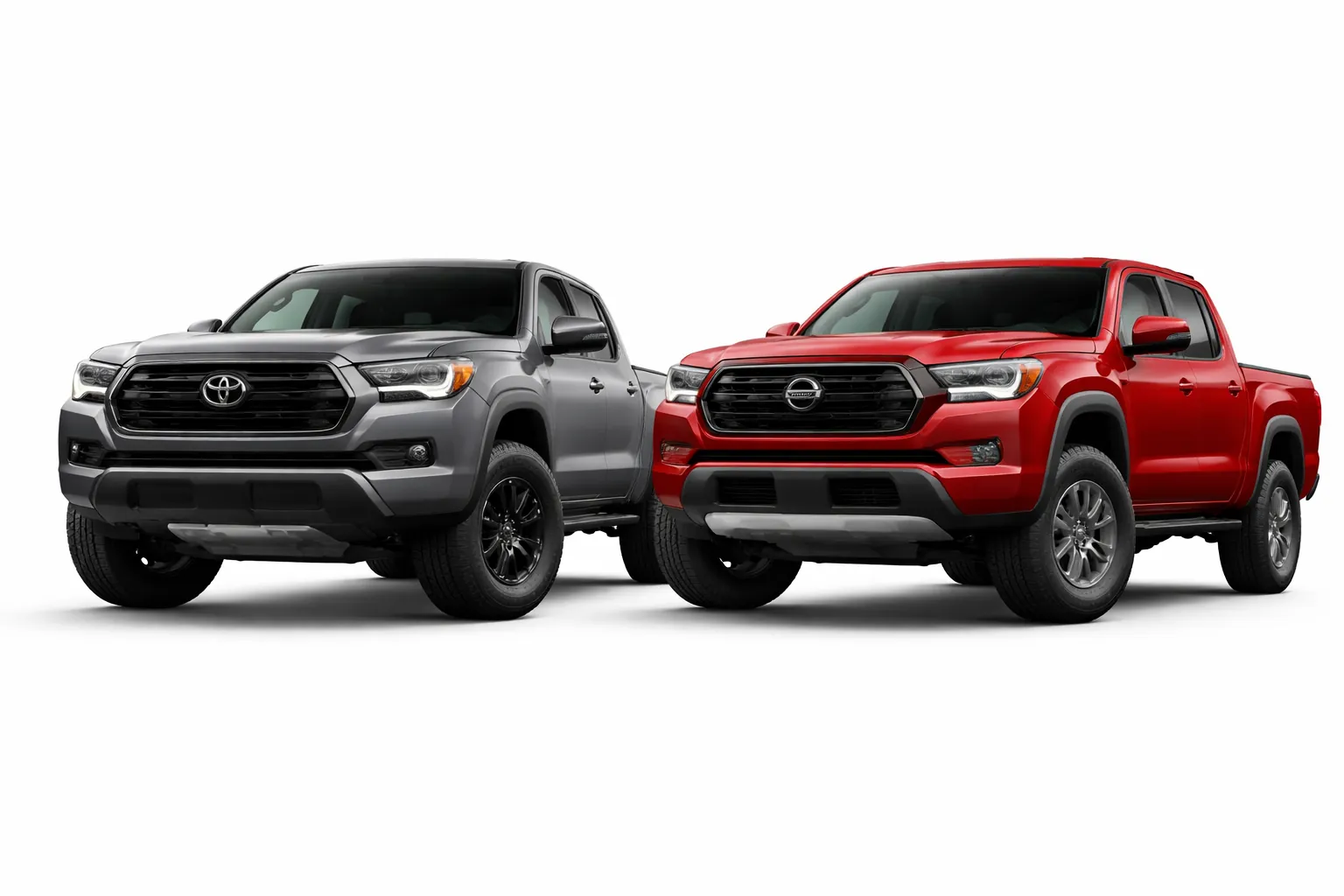
You’re not choosing between “good” and “bad.” You’re choosing between two trucks that both last a long time, but for different reasons—and with different compromises that show up after 80,000 miles, not on a test drive.
The Toyota Tacoma runs on reputation. High resale, simple mechanicals, and a track record that goes back decades. The Nissan Frontier runs on value. Lower purchase price, fewer buyers fighting over it, and in some cases, simpler ownership.
Neither is perfect. Both have blind spots people ignore when they get caught up in brand loyalty.
how these trucks are actually used
Mid-size trucks don’t live the same life as half-tons.
- Daily commuting
- Light towing (trailers under 5,000 lbs)
- Weekend hauling
- Occasional off-road use
You’re not pulling 10,000 lbs across state lines. You’re loading mulch, towing a small camper, or driving 40 miles to work.
That matters. It changes what “better” means.
pricing reality in the used market
This is where the gap starts.
A 2018 Tacoma TRD Off-Road with 80,000 miles:
- $30,000–$34,000
A 2018 Frontier SV with 80,000 miles:
- $22,000–$26,000
Same mileage. Same basic capability. One costs $6,000–$8,000 more.
That difference isn’t because the Tacoma is twice as good. It’s because people trust it more.
You pay for that trust upfront.
engine and transmission differences
toyota tacoma engines
3.5l v6 (2gr-fks)
Main engine since 2016.
Specs:
- 278 hp
- 265 lb-ft torque
Pros:
- Reliable long-term
- Proven platform
- Handles 200,000+ miles with maintenance
Cons:
- Weak low-end torque
- Feels sluggish with automatic transmission
- Gear hunting complaints
The engine isn’t the problem. The transmission is.
Tacoma’s 6-speed automatic struggles to find the right gear. It downshifts too often. Feels busy on the highway.
Real example: 2019 Tacoma in Colorado, 65 mph uphill grade. Transmission drops from 6th to 4th, engine revs past 4,000 RPM just to maintain speed. Driver frustration is common. Not a failure, just poor tuning.
2.7l 4-cylinder
Older base engine.
Pros:
- Simple
- Durable
Cons:
- Underpowered
- Not suited for modern driving
This is a budget option. Nothing more.
nissan frontier engines
4.0l v6 (vq40de) — pre-2020
Old but proven.
Specs:
- 261 hp
- 281 lb-ft torque
Pros:
- Strong low-end torque
- Simple design
- Reliable
Cons:
- Poor fuel economy (15–19 mpg)
- Outdated feel
This engine has been around since the mid-2000s. That’s not a compliment. It works, but it feels old.
3.8l v6 (2020+)
Updated engine.
Specs:
- 310 hp
- 281 lb-ft torque
Pros:
- More power
- Better acceleration
- Paired with 9-speed automatic
Cons:
- Less long-term data
- Still not fuel efficient
The 9-speed transmission shifts better than Tacoma’s automatic. That alone changes the driving experience.
transmission behavior: where the difference shows up daily
Tacoma automatic:
- Gear hunting
- Hesitation
- High RPM under load
Frontier automatic (especially 2020+):
- More predictable
- Smoother shifts
- Better matched to engine
You feel this every day, not just under load.
Tacoma feels like it’s thinking too much.
Frontier just goes.
towing and payload in real terms
Numbers are close on paper.
Tacoma:
- Towing: ~6,400–6,800 lbs
- Payload: ~1,100–1,400 lbs
Frontier:
- Towing: ~6,000–6,700 lbs
- Payload: ~1,200–1,500 lbs
In practice:
Frontier feels stronger off the line when towing.
Tacoma feels more controlled at speed.
Neither is built for heavy towing. Push them too hard and both will show it.
Example: towing a 4,500 lb camper.
- Tacoma: stable, but transmission works hard
- Frontier: stronger initial pull, less shifting
off-road capability: reputation vs reality
Tacoma dominates here—on paper and in aftermarket support.
TRD Off-Road and TRD Pro trims come with:
- Locking rear differential
- Crawl control
- Multi-terrain select
Frontier:
- PRO-4X trim offers similar hardware
- Less aftermarket support
Reality:
Most owners never use these features fully.
Tacoma wins if you actually go off-road regularly. Not gravel roads. Real trails.
Frontier is capable enough for 90% of users.
interior quality and comfort
Tacoma interior:
- Functional
- Durable
- Feels dated, especially 2016–2020
Frontier interior (pre-2022):
- Worse than Tacoma
- Outdated design
- Basic materials
Frontier (2022+ redesign):
- Major improvement
- Better layout
- More modern tech
Still, Tacoma holds value despite interior complaints. That tells you how much buyers prioritize reliability over comfort.
reliability: what actually breaks
toyota tacoma
Common issues:
- Transmission tuning complaints
- Brake wear faster than expected
- Minor electrical glitches
Major failures are rare. That’s why resale stays high.
nissan frontier
Pre-2012 models had radiator/transmission mixing issues (SMOD). That’s mostly gone in newer trucks.
Common issues:
- Aging design problems (older models)
- Fuel economy complaints
- Less refined drivetrain
Post-2020 models haven’t shown widespread catastrophic issues yet.
maintenance and ownership costs
Tacoma:
- Oil changes: $60–$100
- Brakes: $300–$600
- High resale offsets ownership cost
Frontier:
- Similar maintenance costs
- Lower purchase price reduces overall cost
Difference:
Tacoma costs more upfront, less risk long-term.
Frontier costs less upfront, slightly more uncertainty depending on year.
resale value: the biggest gap
Tacoma dominates.
Example:
2017 Tacoma TRD Off-Road, 100k miles:
- ~$28,000
2017 Frontier SV, 100k miles:
- ~$20,000
That’s not a small gap. That’s market perception in action.
Tacoma owners recover more money when selling.
Frontier owners save money when buying.
real-world ownership example
Two buyers. Same budget: $30,000.
Buyer A:
- 2019 Tacoma TRD Off-Road
- 85,000 miles
Outcome:
- High resale value
- Reliable
- Frustrating transmission behavior daily
Buyer B:
- 2022 Frontier SV
- 40,000 miles
Outcome:
- Newer truck
- Better driving experience
- Lower resale later
Both made rational decisions. Just different priorities.
the trade-offs spelled out clearly
Tacoma:
- Higher cost
- Better resale
- Proven reliability
- Worse transmission behavior
Frontier:
- Lower cost
- Better driving feel (newer models)
- Less resale value
- Older reputation issues
what buyers get wrong
They assume Tacoma is automatically better.
It’s not. It’s safer financially because of resale and reliability history.
They ignore driving experience.
Tacoma’s transmission behavior annoys owners daily. That matters more than people admit.
They overlook Frontier improvements.
The 2022+ redesign fixed a lot of problems. Many buyers still treat it like the 2008 version. That’s outdated thinking.
stripped-down decision logic
Choose Tacoma if:
- You care about resale value
- You want long-term reliability with minimal risk
- You don’t mind a less refined driving experience
Choose Frontier if:
- You want better value upfront
- You prefer smoother transmission behavior
- You accept lower resale
final assessment without padding
The Toyota Tacoma is the safer financial bet. It holds value and avoids major failures.
The Nissan Frontier is the better deal per dollar, especially newer models with the 3.8L engine and 9-speed transmission.
Neither dominates completely. One protects your money later. The other saves it now.

Comments (0)
No comments yet.