
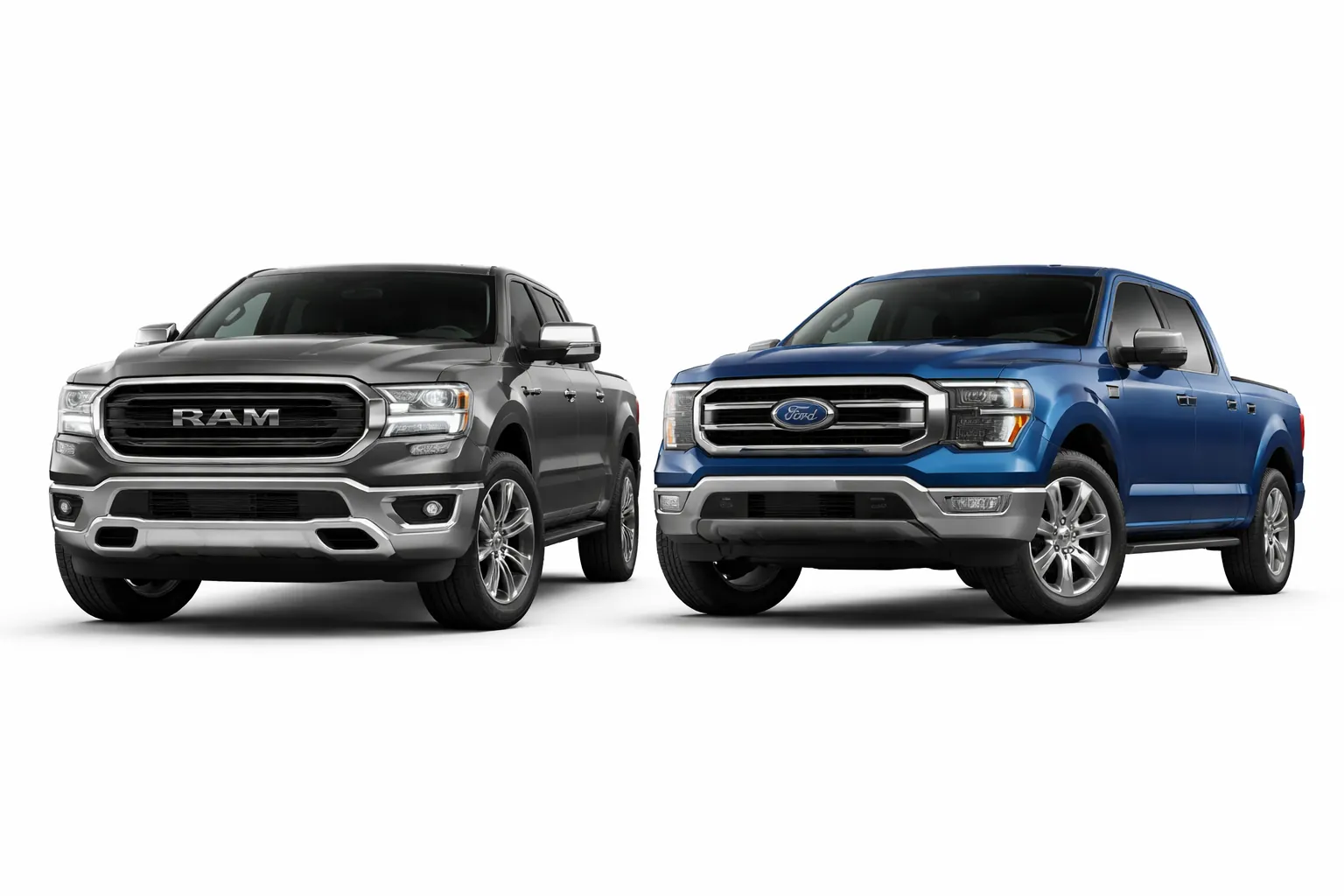
You’re not comparing brands. You’re comparing trade-offs that show up fast in Nebraska—cold starts in January, crosswinds on I-80, long highway miles between towns, and real towing, not brochure numbers.
The Ram 1500 leans toward ride quality and interior comfort. The Ford F-150 leans toward engine variety, payload, and resale. Both can be good used buys. Both can burn you if you pick the wrong year, engine, or previous owner.
No brand loyalty here. This is about what holds up, what breaks, and what costs money in Nebraska conditions.
what nebraska actually does to a truck
Flat doesn’t mean easy. Nebraska driving is steady load.
- Long highway runs at 70–80 mph
- Strong crosswinds, especially west of Kearney
- Winter cold snaps below 0°F
- Farm and gravel road use outside cities like Grand Island or North Platte
That combination exposes weak transmissions, cheap interiors, and engines that don’t like cold starts.
A truck that feels fine on a 20-minute test drive in Omaha can feel worn out after three months of daily I-80 miles.
core mechanical philosophy: ram vs ford
Ram Trucks builds trucks that feel softer. Coil spring rear suspension (since 2009) instead of leaf springs. Smoother ride. Better for daily driving. Worse for heavy payload stability.
Ford Motor Company builds the F-150 around versatility. More engine options. Higher payload ratings. Aluminum body since 2015. Lighter, but repair costs go up after accidents.
You feel the difference immediately.
Ram feels like a half-ton SUV with a bed.
F-150 feels like a tool first, daily driver second.
engines that actually matter in the used market
ram 1500 engines
5.7l hemi v8
This is the one you’ll see most.
Specs:
- 395 hp
- 410 lb-ft torque
Pros:
- Strong acceleration
- Simple design compared to turbo engines
- Good towing feel
Cons:
- Exhaust manifold bolt failures (common around 80k–120k miles)
- “Hemi tick” complaints—sometimes harmless, sometimes not
- Fuel economy: 15–21 mpg
Real case: 2016 Ram 1500 in Lincoln, 92,000 miles. Cold start ticking noise. Dealer quote: $1,200 to fix broken exhaust manifold bolts. Owner ignored it for months. Noise got worse but didn’t kill the engine. Still drives, just louder.
3.6l pentastar v6
Base engine.
Pros:
- Reliable overall
- Lower purchase price
- 17–25 mpg
Cons:
- Weak for towing
- Feels strained under load
This is fine for commuting. It’s not a work truck.
ecodiesel 3.0l
Pros:
- 25–30 mpg highway
- Strong torque
Cons:
- EGR and emissions system failures
- Expensive repairs outside warranty
Known issue: EGR cooler failures. Repair bills can hit $2,000–$4,000.
ford f-150 engines
5.0l coyote v8
The straightforward option.
Specs:
- ~395 hp (varies by year)
Pros:
- No turbo complexity
- Good reliability record
- Strong resale
Cons:
- Oil consumption in some 2018–2020 models
- Less torque than EcoBoost engines
This engine ages well if maintained.
3.5l ecoboost v6
Most popular modern F-150 engine.
Pros:
- High torque (470 lb-ft in newer versions)
- Strong towing performance
- Better fuel economy than V8 under light load
Cons:
- Timing chain stretch (early models)
- Carbon buildup
- Turbo replacement costs
Example: 2015 F-150 in Omaha, 110,000 miles. Timing chain rattle on startup. Repair cost: $2,800. Owner delayed it. Chain jumped timing six months later. Engine damage followed.
2.7l ecoboost
Underrated.
Pros:
- Reliable for a turbo engine
- 20–26 mpg
- Good daily driver
Cons:
- Not ideal for heavy towing
- Turbo complexity still exists
3.3l v6
Basic. Rarely discussed.
Pros:
- Simple
- Cheap
Cons:
- Underpowered
- Low resale demand
transmissions: one does better under stress
Ram pairs most engines with the ZF 8-speed automatic.
This transmission is one of the better ones in half-ton trucks. Smooth shifts. Holds up under normal towing. Fewer widespread complaints compared to others.
Ford uses a 6-speed in older models, then a 10-speed (after 2017).
The 10-speed has issues:
- Harsh shifting
- Gear hunting at low speeds
- Software updates required
Some trucks behave fine. Others never feel right.
This is not theoretical. It shows up in daily driving.
ride quality vs payload: pick one
Ram’s coil spring suspension rides better. No debate.
You feel it on broken pavement outside towns like Hastings. Less bounce. Less rear-end hop when empty.
But payload suffers.
Typical numbers:
- Ram 1500 payload: ~1,500–1,900 lbs
- F-150 payload: ~1,800–2,300 lbs
If you haul gravel, tools, or equipment regularly, the F-150 handles it better. Less squat. More stable under load.
Ram wins comfort.
Ford wins work capacity.
towing in real conditions
Paper numbers don’t tell the story.
Real-world Nebraska towing means:
- Wind resistance
- Long distances
- Steady strain, not short bursts
F-150 EcoBoost engines handle this better. Turbo torque holds speed on hills and into wind.
Ram HEMI does fine, but fuel economy drops hard under load. Single digits are common when towing over 7,000 lbs.
Example: hauling a 6,500 lb camper from Omaha to Scottsbluff.
- Ram 1500 HEMI: ~9 mpg
- F-150 3.5 EcoBoost: ~11–12 mpg
Not huge, but noticeable over 400 miles.
interiors: one is clearly better
Ram dominates here, especially 2019 and newer.
Large touchscreen (12-inch optional). Better materials. Feels closer to a luxury SUV.
Ford improved interiors in 2021 redesign, but older models (2015–2020) feel basic.
If you spend hours driving across the state, this matters.
A 2018 F-150 XLT feels like a work truck.
A 2019 Ram Laramie feels like something else entirely.
rust, body, and long-term durability
Ford switched to aluminum body panels in 2015.
Pros:
- No rust on body panels
- Lighter weight
Cons:
- Repair costs higher after accidents
- Harder to find cheap body shop work
Ram uses steel.
Pros:
- Easier, cheaper repairs
- Traditional construction
Cons:
- Rust shows up in wheel wells and underbody, especially in salted areas
Nebraska winters aren’t as harsh as the upper Midwest, but rust still appears over time.
ownership costs that actually hit your wallet
ram 1500
- Exhaust manifold repair: $800–$1,500
- Air suspension (if equipped): $1,500–$3,000 per failure
- Fuel economy worse with V8
ford f-150
- Timing chain (EcoBoost): $2,000–$3,500
- Turbo replacement: $1,500–$2,500
- 10-speed transmission fixes vary widely
Neither truck is cheap to own long-term. The difference is where the money goes.
Ram hits you with smaller, frequent issues.
Ford hits you with occasional larger ones.
resale value in nebraska
F-150 wins.
It sells faster. Holds value better. More demand across rural and urban buyers.
Example (2025 market snapshot):
- 2018 F-150 XLT, 90k miles: ~$27,000
- 2018 Ram 1500 Big Horn, 90k miles: ~$24,000
Same mileage. Similar condition. Ford still pulls ahead.
real-world comparison: same budget, different outcomes
Budget: $28,000.
Option 1:
- 2019 Ram 1500 Big Horn
- 70,000 miles
- HEMI V8
Outcome:
- Comfortable daily driving
- Lower payload
- Potential exhaust manifold repair within 30k miles
Option 2:
- 2018 F-150 XLT
- 75,000 miles
- 3.5 EcoBoost
Outcome:
- Better towing
- Higher resale
- Possible timing chain or turbo maintenance
Neither is “better.” One fits specific use better.
common mistakes buyers make
They focus on trim instead of drivetrain.
A Laramie badge doesn’t fix mechanical issues.
An XLT with the right engine is a better truck than a loaded trim with problems.
They ignore previous use.
A farm truck with 80,000 miles is not equal to a commuter truck with 80,000 miles.
They assume newer equals better.
A 2021 truck with poor maintenance is worse than a clean 2016.
the actual decision line
Choose Ram if:
- You drive long distances daily
- You care about ride comfort
- You don’t max out payload
Choose F-150 if:
- You tow or haul regularly
- You want stronger resale
- You prefer engine variety
That’s it. No brand loyalty angle.
the trade-offs spelled out
Ram gives comfort and a better interior. You accept lower payload and some recurring issues.
Ford gives capability and resale. You accept more complex engines and occasional expensive repairs.
Neither is clean. Both require attention.
stripped-down conclusion without filler
The Ram 1500 is easier to live with day to day. The Ford F-150 is better when the truck is actually used like a truck.
Nebraska driving exposes weaknesses fast. Long miles, wind, and cold don’t hide problems.
You don’t pick based on brand. You pick based on engine, transmission, and how the last owner treated it.

Comments (0)
No comments yet.