
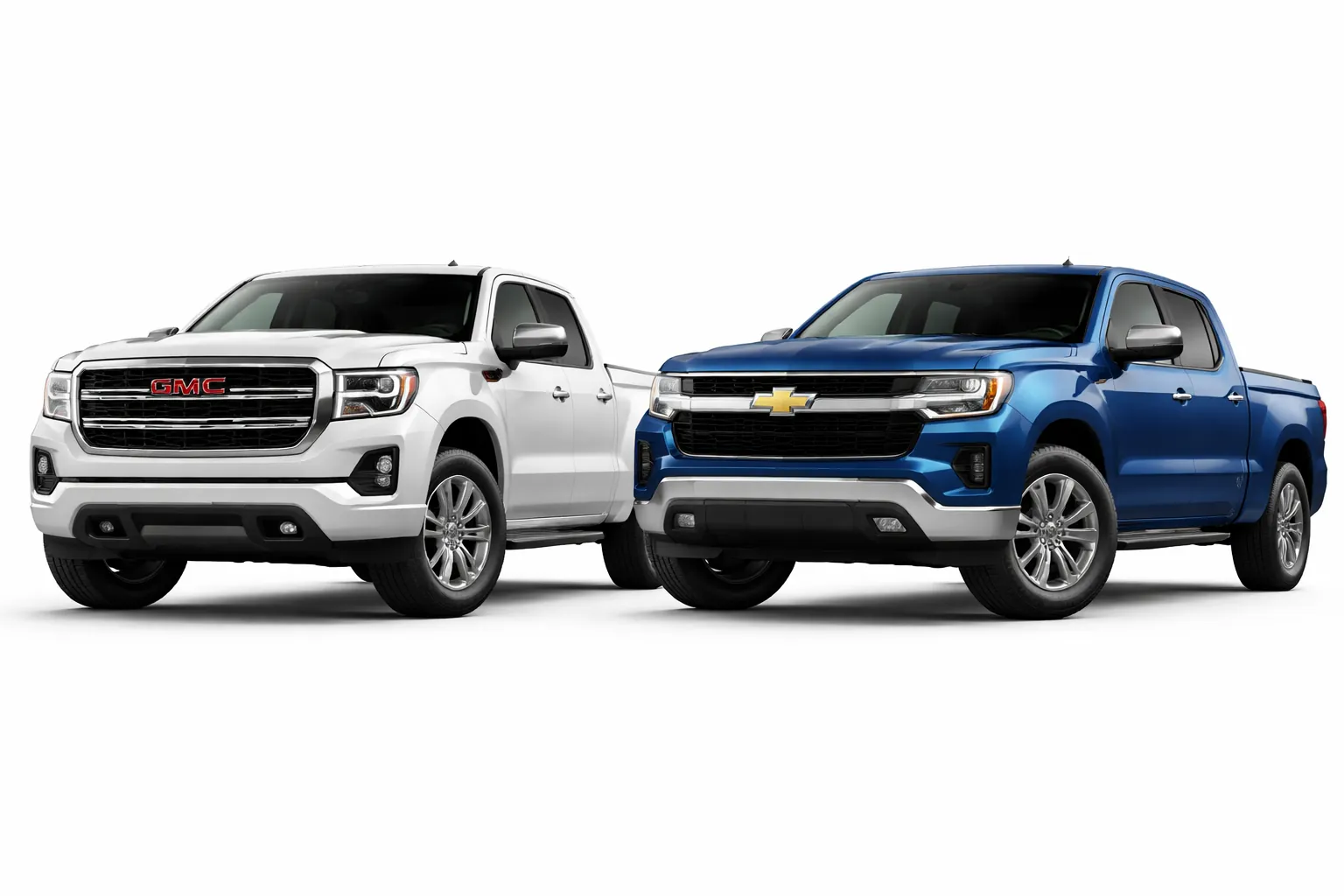
You’re comparing twins with different clothes. The GMC Sierra 1500 and Chevrolet Silverado 1500 share engines, frames, transmissions, and most mechanical parts under General Motors. Same bones. Same problems. Same repair bills.
The difference shows up in trim, pricing, and how they’re marketed. Sierra leans “premium.” Silverado leans “work truck.” That sounds simple. It isn’t. Because once these trucks hit the used market, that premium label doesn’t always translate into better ownership.
You’re not picking a better truck. You’re deciding whether small upgrades justify higher cost, knowing the mechanical risk stays the same.
the shared platform reality
Start here. Strip badges off both trucks and you’re left with this:
- Same engines: 4.3L V6, 5.3L V8, 6.2L V8, 2.7L turbo, 3.0L diesel
- Same transmissions: 6-speed, 8-speed, 10-speed
- Same frame and suspension design
- Same core reliability issues
This matters. Because buyers assume Sierra is “more reliable” due to price. It’s not.
If a 2017 Silverado with a 5.3L has lifter failure risk, a 2017 Sierra with the same engine has it too. No difference.
pricing gap in the used market
Sierra costs more. Not a little. Consistently more.
Example from 2025 listings:
- 2018 Silverado LT, 85,000 miles: $26,000–$29,000
- 2018 Sierra SLT, 85,000 miles: $29,000–$33,000
Same mileage. Same engine. Same transmission.
You’re paying $3,000–$4,000 extra for:
- Interior materials
- Exterior styling
- Trim packaging
Not for better durability.
That gap widens on higher trims like Denali.
engines: identical strengths and identical problems
5.3l v8
This is the backbone.
Specs:
- 355 hp
- 383 lb-ft torque
Pros:
- Widely available
- Easy to service
- Good balance of power and efficiency
Cons:
- AFM/DFM lifter failures
- Oil consumption complaints
- Mediocre fuel economy (17–21 mpg combined)
This engine doesn’t care if it’s in a Sierra or Silverado. It behaves the same.
Real case: 2018 Sierra SLT in Kansas City, 78,000 miles. Engine tick on startup. Dealer diagnosed lifter failure. Repair quote: $3,600. Same issue shows up in Silverado forums weekly.
6.2l v8
More power. Same risks.
Specs:
- Up to 420 hp
Pros:
- Strong acceleration
- Better towing feel
Cons:
- Premium fuel recommended
- Same lifter failure risk
- Higher repair costs
You’re paying more for performance, not reliability.
2.7l turbo
Smaller engine, newer design.
Pros:
- Strong torque for size
- Better fuel economy
Cons:
- Long-term durability still uncertain
- Turbo complexity
Shows up in both trucks. No difference in reliability between brands.
3.0l duramax diesel
Quiet, efficient.
Pros:
- 27–30 mpg highway
- Strong torque
Cons:
- Expensive emissions repairs
- Diesel maintenance costs
Again, identical in both trucks.
transmissions: same issues, same risk
6-speed automatic (6l80)
Reliable. Basic. Common in 2014–2018 models.
No major difference between Sierra and Silverado.
8-speed automatic (8l90)
Problem area.
Issues:
- Shudder at highway speeds
- Harsh shifts
- Torque converter problems
Example: 2016 Silverado LT in Texas, 90,000 miles. Transmission shudder at 65 mph. Fluid flush didn’t fix it. Replacement cost: $4,200. Same issue reported in Sierra Denali models from the same years.
Trim level doesn’t protect you.
10-speed automatic
Better than the 8-speed. Still not perfect.
Smoother shifts. Fewer complaints. Used in newer models.
ride quality and handling
No real difference.
Both use:
- Independent front suspension
- Solid rear axle
Ride quality depends more on:
- Tire choice
- Suspension wear
- Trim level
Sierra sometimes feels quieter due to better insulation in higher trims. That’s not a mechanical advantage. It’s just sound deadening.
interior differences: this is where the money goes
This is the real split.
silverado interior
- Functional
- More hard plastics
- Basic layout in lower trims
It does the job. Doesn’t impress.
sierra interior
- Better materials
- More leather in mid-level trims
- Cleaner design
Denali trims go further:
- Real wood accents
- Higher-end finishes
- More tech features
Here’s the catch. After 80,000 miles, wear levels out.
Leather cracks. Buttons fade. Screens glitch in both trucks.
You paid more upfront for something that doesn’t age dramatically better.
tech and features
Sierra usually gets features earlier or bundles them differently.
Examples:
- Heads-up display (Denali)
- MultiPro tailgate
- More standard driver-assist features
Silverado offers similar features, but often in higher trims or packages.
Real-world use:
Most owners use:
- Backup camera
- Bluetooth
- Basic infotainment
The rest becomes background noise after a few months.
the multipro tailgate vs standard tailgate
Sierra’s MultiPro tailgate is one of the few real differences.
It folds in multiple ways:
- Step access
- Work surface
- Load stop
Useful? Yes, in specific situations.
Worth $3,000 more on the used market? Depends on how often you use it.
Most owners use it a few times, then go back to treating it like a normal tailgate.
reliability: no brand advantage
This is where buyers get it wrong.
They assume Sierra is more reliable because it costs more.
Reality:
- Same engines
- Same transmissions
- Same failure points
Lifter failure doesn’t care about trim.
Transmission shudder doesn’t care about branding.
If one fails, the other fails.
ownership costs
shared costs
- Oil changes: $60–$120
- Brake jobs: $300–$600
- Tires: $800–$1,200
common repairs
- Lifter replacement: $2,500–$4,000
- Transmission rebuild: $3,000–$5,000
- AC compressor: $800–$1,500
No difference between Sierra and Silverado.
resale value
Sierra holds slightly higher resale, but not enough to offset the initial price gap.
Example:
- 2018 Silverado LT, 100k miles: ~$24,000
- 2018 Sierra SLT, 100k miles: ~$26,000
You paid $4,000 more. You recover maybe $2,000 more.
You still lose money.
real-world example: same truck, different badge
Two buyers in Oklahoma.
Buyer A:
- 2017 Silverado LT
- 5.3L V8
- 88,000 miles
- Paid $27,000
Buyer B:
- 2017 Sierra SLT
- Same engine, same mileage
- Paid $31,000
At 105,000 miles:
Both trucks develop lifter noise.
Both need $3,200 repairs.
Buyer B paid more upfront and got the same problem.
where the sierra actually makes sense
- You want a nicer interior
- You value small comfort upgrades
- Price difference is minimal in your market
That’s it.
Not reliability. Not performance. Not durability.
where the silverado makes more sense
- You want lower upfront cost
- You don’t care about premium trim
- You plan to use the truck as a tool
You get 90% of the same truck for less money.
common buyer mistakes
They think Sierra is a luxury upgrade that changes ownership experience.
It doesn’t. It changes how the truck feels for the first year. After that, it’s the same maintenance and repair cycle.
They ignore drivetrain details.
A Silverado with a 6-speed transmission is a better buy than a Sierra with an 8-speed. Badge doesn’t matter. Components do.
They overpay for Denali trims.
Denali looks good. It doesn’t age differently than other trims.
the trade-offs spelled out
Sierra:
- Higher upfront cost
- Better interior
- Slightly higher resale
Silverado:
- Lower cost
- Same mechanical performance
- Better value per dollar
Both:
- Same reliability risks
- Same repair costs
stripped-down conclusion without filler
The GMC Sierra 1500 is a Silverado with nicer trim and a higher price.
The Chevrolet Silverado 1500 is the same truck without the markup.
You don’t get better durability or reliability by paying more. You get a better interior for a while. After that, both trucks age the same and break the same way.

Comments (0)
No comments yet.